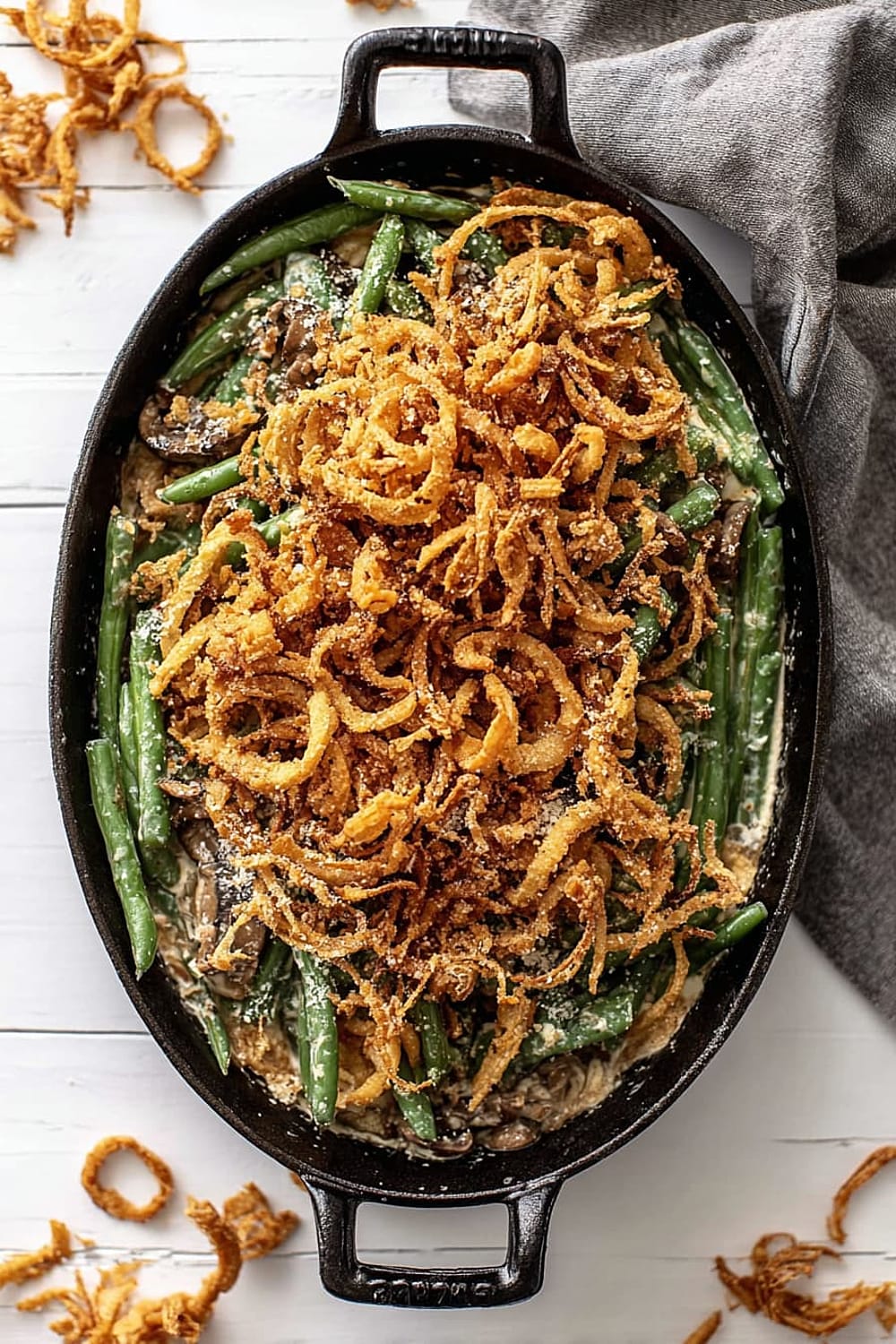
The best fried onion for green bean casserole is thinly sliced yellow or white onion coated in flour and fried until crisp and golden. Add most of the onions near the end of baking, then scatter a fresh layer on top for the best crunch.
Green bean casserole is a favorite side dish on many American Thanksgiving tables. It also fits right in at Christmas dinner, Sunday lunch, or a simple weeknight meal. The creamy green beans taste good on their own, but the crisp onion topping makes each bite better.
Store-bought French fried onions save time, while homemade fried onions let you choose the onion, coating, and seasoning. Both can work well in a classic casserole. The main goal is to keep the onions crisp without letting them burn or turn soggy in the creamy sauce.
This guide explains how to make fried onion for green bean casserole at home, which onions to use, how much to prepare, and when to add them. You will also learn how to bake the casserole without losing that golden crunch. The methods use common US kitchen tools and ingredients.
Source: assets.epicurious.com
What Makes Fried Onion So Good on Green Bean Casserole?
Fried onions add crunch, savory flavor, and a little sweetness to green bean casserole. Their crisp texture contrasts with the soft green beans and creamy mushroom sauce. That contrast is a big part of what makes the dish so appealing.
The onions also add flavor without the need for a long list of seasonings. As onions cook, their sharp raw taste softens and their natural sugars brown. The result is a savory topping with a mild sweet note.
A good topping should stay crisp long enough to serve the casserole. That can be tricky because the sauce contains moisture. If fried onions sit in the sauce for too long, they absorb water and lose their crunch.
Source: happymuncher.com
Texture
Crisp onions provide a firm bite against tender beans and thick sauce.
Flavor
Browned onions add a rich, savory taste with mild sweetness.
Appearance
Golden onion pieces give the casserole a classic baked finish.
Store-Bought or Homemade Fried Onions?
Packaged French fried onions are convenient and give you a ready-to-use topping. They are often seasoned and coated, so you do not need to slice, bread, or fry onions yourself. Follow the package directions for the best result.
Homemade fried onions offer more control over flavor and texture. You can choose the onion type, adjust the salt, and use a coating that suits your needs. They also allow you to make a small batch when you do not need a whole container.
Choose packaged onions
Use them when time is short or when you want a familiar casserole topping with little effort.
Choose homemade onions
Make them when you want control over seasoning, coating, and the size of each piece.
Which Onions Are Best for Green Bean Casserole?
Yellow onions are the best all-purpose choice for homemade fried onions. They have a balanced flavor, are widely available, and brown well when cooked. Their taste works with green beans, cream-based sauce, mushrooms, and common holiday seasonings.
White onions also work well. They tend to have a sharper taste when raw, but frying softens that bite. They are a useful choice when you want a more direct onion flavor.
Sweet onions, such as Vidalia onions when in season, offer a milder flavor. Their higher moisture content can affect how quickly they crisp, so slice them thinly and fry in small batches. Red onions can be used, too, although their color and flavor may differ from the classic golden topping.
Source: i.pinimg.com
Yellow onion
A dependable choice for a balanced flavor and golden color.
White onion
Good for a sharper onion taste that mellows during frying.
Sweet onion
Useful for a mild, slightly sweet topping, but watch moisture and browning.
Shallots
Make smaller, delicate fried pieces with a sweet and savory taste.
How Thin Should You Slice the Onions?
Aim for slices about 1/8 inch thick. Thin slices cook quickly and can become crisp before the coating gets too dark. A sharp knife or a mandoline can help create even slices, though a knife is enough for a small batch.
Try to keep the slices close in size. Thick pieces may stay soft in the middle while very thin pieces turn dark too fast. If using a mandoline, use its hand guard and keep your fingers away from the blade.
For long onion strips
Cut the onion in half from top to root, peel it, and slice across the layers.
For small crisp pieces
Cut the onion into thin rings, then separate the rings before coating.
Easy Homemade Fried Onion Recipe
You can make crisp fried onions with a few basic ingredients. For a standard green bean casserole, one medium onion is a useful starting point. The final amount will vary with the onion size, slice thickness, and how much moisture cooks away.
This method uses a light flour coating and shallow frying in a deep, heavy pan. It produces a crisp topping that works well with a classic creamy casserole. Keep the heat steady and remove each batch as soon as it turns golden.
Source: life-in-the-lofthouse.com
Prep time
About 15 minutes, including slicing and coating.
Cook time
About 10 to 20 minutes, depending on the pan and batch size.
Yield
One medium onion makes a modest topping; prepare more for a thick layer or a large casserole.
Ingredients You Need
Gather the ingredients before heating the oil. The onion slices should be ready to coat, and the draining area should be set up before frying starts. Once the onions enter the hot oil, the process moves quickly.
1 medium yellow onion
Peel it and slice it into thin, even rings or strips.
1/2 cup all-purpose flour
Use enough to coat the onion lightly, with a little extra if needed.
1/2 teaspoon fine salt
Season the flour, then adjust the salt to suit your casserole.
1/4 teaspoon black pepper
Adds mild warmth without overpowering the onion.
Neutral frying oil
Use enough for a shallow layer in the pan, or more if deep-frying.
Step 1: Slice and Separate the Onion
Peel the onion and cut it into thin slices. Separate the rings with your fingers so the flour can reach more of the surface. If the slices feel very wet, pat them gently with a clean paper towel.
Do not soak the onion unless your recipe calls for it. Extra water can make the coating harder to keep crisp and may cause hot oil to splatter.
Check the slices
Set aside any very thick pieces and slice them again for more even cooking.
Step 2: Coat the Onion Lightly
Mix the flour, salt, and pepper in a bowl. Add a handful of onion slices and toss until each piece has a thin coat. Shake off loose flour before the onions go into the oil.
A light coating is enough. Too much flour can form clumps, darken unevenly, or leave a heavy taste. If the coating will not stick at all, a small amount of moisture on the onion may help, but avoid adding water directly to hot oil.
Keep batches separate
Coat only the amount you can fry at one time, so the remaining onions do not sit in damp flour.
Step 3: Heat the Oil
Heat the oil in a sturdy pan over medium to medium-high heat. Aim for about 350°F if you have a kitchen thermometer. The oil should be hot enough to cook the coating quickly without scorching it.
Avoid filling the pan too high. Leave plenty of room for the onions and for safe handling. Never add water to hot oil, and keep children and pets away from the cooking area.
Without a thermometer
Test one small coated onion piece. It should sizzle when added, but the oil should not smoke. A thermometer is more reliable than judging by sight alone.
Step 4: Fry Until Golden
Add a small handful of coated onion slices to the hot oil. Spread them out and stir gently so they cook on more than one side. Fry until golden brown and crisp, often around 2 to 4 minutes per batch for thin slices, though thickness and oil temperature change the timing.
Watch the color closely near the end. Onions can go from golden to burnt in a short time. Remove them with a slotted spoon when they look pale golden to medium golden, as they may darken a little after leaving the oil.
Do not crowd the pan
Too many onions at once can lower the oil temperature and lead to greasy, soft pieces.
Step 5: Drain and Cool
Place the fried onions on a wire rack or a plate lined with paper towels. Spread them into a loose layer instead of piling them up. This lets steam escape and helps the coating stay crisp.
Taste one after it cools enough to handle. Add a small pinch of salt if needed, but remember that canned soup, broth, and packaged onions may already contain salt. Let the onions cool fully before storing them.
Best sign of success
The onion should feel crisp on the outside and have a cooked, mellow flavor rather than a raw bite.
How Much Fried Onion Does a Casserole Need?
The right amount depends on the size of the casserole dish and how much crunch you like. For a typical casserole made with about 1 pound of green beans, one small to medium onion may be enough for a modest homemade topping. You may want more if you like a thick, crisp layer.
A common American green bean casserole recipe uses a 6-ounce can of French fried onions, though recipes vary. Check your chosen recipe and package size rather than assuming all containers hold the same amount. Homemade onions also vary in yield because frying removes moisture and reduces the volume of the raw onion.
Source: happymuncher.com
Small casserole
Start with about 1 to 2 cups of loosely piled fried onions, then add more if you want a thicker topping.
Standard family casserole
Use enough onions to cover the surface in a single layer, with a little extra for serving.
Large holiday casserole
Prepare a larger batch and keep some onions aside to refresh the topping just before serving.
A Simple Way to Estimate the Amount
The easiest method is to spread the fried onions across the top of the unbaked casserole without pressing them down. You should see a fairly even layer, with few large gaps. If you prefer a crunchy top on every serving, keep a little extra ready for the table.
For a casserole with a deep layer of sauce, the topping may sink slightly as the dish bakes. Add the final portion near the end of cooking instead of placing every onion into the oven at the start.
For even coverage
Distribute onions from edge to edge instead of leaving a large mound in the center.
When Should You Add Fried Onions to Green Bean Casserole?
For the crispest result, add most of the fried onions near the end of baking. A common approach is to bake the green bean mixture first, add the topping for the final 5 to 10 minutes, and return the dish to the oven until the onions are warm and lightly golden. Follow your base recipe if it gives a different timing.
Some classic recipes mix part of the packaged onions into the casserole before baking and reserve the rest for the top. This adds onion flavor throughout the dish. The trade-off is that onions mixed into the sauce will soften, so save enough for a fresh top layer.
Homemade fried onions can brown faster than expected because they are already cooked. Watch the casserole closely during the final minutes. Remove it when the sauce is hot and the topping has the color and texture you want.
Source: plumandpan.com
For maximum crunch
Add the onions after the casserole is mostly baked, or sprinkle them on just before serving.
For onion flavor throughout
Mix a small portion into the green bean mixture and reserve the rest for the top.
For a make-ahead dish
Keep the topping separate until the final baking stage.
Can You Put Fried Onions on Before Baking?
Yes, you can add fried onions before baking, but the texture may be softer by the time the casserole is done. Moisture from the sauce and steam released during baking can soften the coating. A longer bake may also make thin onions too dark.
If your recipe calls for topping the casserole at the start, use its stated temperature and cooking time. Check the top during the last part of baking and cover the dish loosely with foil if the onions darken too quickly. Keep the foil above the topping so it does not crush the onions.
Best general approach
Bake the casserole first, add the onions later, and avoid extra oven time once they are golden.
How to Keep Fried Onions Crispy
The key to crisp fried onions is controlling moisture at every stage. Thin slices, a light coating, hot oil, and proper draining all help. Once the onions are cooked, let them cool in a single layer before storing them or adding them to the casserole.
Do not cover hot fried onions with a lid. Trapped steam can soften the coating. For the same reason, avoid placing a large pile of hot onions in a deep bowl while they cool.
The casserole itself also affects the topping. A very thin sauce can soak into the onions more quickly, while a thick sauce may help keep the top in place. The onions will still soften over time, so add them as close to serving as your schedule allows.
Source: gabbyrecipes.com
Dry the onion slices
Remove excess surface moisture before coating and frying.
Maintain oil heat
Use small batches and let the oil recover between them.
Drain in a single layer
Use a rack or paper towels and allow steam to escape.
Keep the topping separate
Store the onions apart from the casserole until needed.
Why Are My Fried Onions Soggy?
Soggy onions usually point to excess moisture, crowded frying, low oil heat, or early contact with the casserole sauce. Each issue has a simple fix. Check the oil temperature and batch size first, then review how the onions were drained and stored.
If the onions are already soft, you may be able to restore some crunch by spreading them on a baking sheet and warming them briefly in a moderate oven. Watch them closely because they can burn quickly. This works best before they have soaked up casserole sauce.
Cause: low oil temperature
Fix: let the oil return to the target temperature before frying the next batch.
Cause: too much coating
Fix: shake off excess flour and separate clumps before frying.
Cause: trapped steam
Fix: cool the onions in a single layer without covering them.
Cause: early topping
Fix: add the onions near the end of baking or just before serving.
Seasoning Ideas for Homemade Fried Onions
A small amount of seasoning can give homemade fried onions more flavor without covering up the taste of the green beans. Salt and black pepper are enough for a classic version. You can also adjust the seasoning to suit the rest of your meal.
Seasonings are best added to the flour before frying or sprinkled on the onions while they are still warm. Add only a little at first. Packaged soup, cheese, broth, and canned vegetables can all contribute salt to the finished casserole.
Source: seededatthetable.com
Garlic powder
Adds a savory note that works well with mushroom sauce.
Paprika
Adds mild warmth and a deeper golden appearance.
Black pepper
Balances the mild sweetness of cooked onion.
Dried thyme
Adds a light herbal flavor that pairs well with green beans.
A pinch of cayenne
Gives the topping a little heat without changing the recipe too much.
How to Make a Gluten-Free Fried Onion Topping
For a gluten-free version, replace wheat flour with a gluten-free all-purpose flour blend or a suitable fine rice flour. The texture can vary by blend, so fry a small test batch before coating the whole onion. Some blends brown faster than wheat flour.
Check labels on packaged fried onions, seasonings, and other ingredients if you need to avoid gluten. Also make sure your utensils, oil, and cooking surfaces have not been contaminated by wheat flour. A gluten-free topping alone does not make the whole casserole gluten-free.
Use a suitable coating
Choose a gluten-free flour blend that works for frying and follow its package guidance.
Check every ingredient
Review soup, broth, seasoning, and packaged toppings for gluten-containing ingredients and cross-contact warnings.
Can You Make Fried Onions Ahead of Time?
You can prepare homemade fried onions ahead, but the best storage method depends on how long you need to keep them. For the crispest result, make them close to serving time. If preparing earlier, cool them completely before placing them in a clean, dry, airtight container.
Moisture is the main enemy of a crisp coating. Do not seal the onions while they are warm, since trapped steam can soften them. Keep the container away from heat and moisture, and discard onions that develop an unusual smell, visible mold, or other signs of spoilage.
For longer storage, freezing may be an option, although the texture can change. Spread the onions in a single layer to freeze, then transfer them to a suitable freezer container. Reheat them in an oven until crisp, and check frequently to prevent burning.
Source: engxv9rxsd7.exactdn.com
For same-day use
Cool completely, then store in an airtight container in a dry spot.
For next-day use
Check that the onions remain dry and crisp before adding them to the casserole.
For longer storage
Freeze in a single layer before packing, then reheat carefully to restore some crispness.
How to Reheat Fried Onions
A low to moderate oven can help bring back some crispness. Spread the onions on a baking sheet and heat them for a few minutes, checking often. The exact time depends on their thickness and how much moisture they have absorbed.
An air fryer may also work for a small batch. Use a low setting if your appliance allows it and shake the basket gently as needed. Thin onions can burn fast, so do not leave them unattended.
Avoid sealing them hot
Let the onions cool before returning them to storage.
Reheat only what you need
Small batches are easier to crisp evenly and less likely to burn.
Common Mistakes to Avoid
Small mistakes can change the texture of fried onions more than you might expect. A good coating and steady oil heat matter, but timing is just as important. The following checks can help you avoid a burnt, greasy, or soggy topping.
Source: happymuncher.com
Cutting uneven slices
Thin slices may burn while thick slices stay soft. Keep the slices close to the same thickness.
Using too much flour
A thick layer may taste pasty or form clumps. Shake off loose flour before frying.
Frying too many onions at once
Crowded onions can cool the oil and turn greasy. Fry in small batches.
Letting the oil smoke
Smoking oil is too hot for controlled frying. Lower the heat and let it cool to a suitable temperature before continuing.
Adding all the onions too early
Long exposure to sauce and steam can soften the topping. Reserve a fresh layer for the end.
Leaving hot onions in a deep pile
Steam can collect between the pieces. Spread the onions out while they cool.
What If the Onions Burn Before They Turn Crisp?
Burnt onions often mean the oil is too hot, the coating is too thick, or the slices are too thin. Lower the heat and test a fresh piece before adding another batch. Do not use onions that taste bitter or have blackened badly.
If the oil starts to smoke heavily, turn off the heat and move the pan only if it is safe to do so. Never pour water onto hot oil. If oil catches fire, do not carry the pan or use water; turn off the heat only if safe and use an appropriate fire extinguisher or fire blanket according to its instructions.
Correct the temperature
Use a thermometer when possible and let the oil return to the right range before frying again.
Frequently Asked Questions
Q
Can I use regular fried onions instead of French fried onions?
Yes. Homemade fried onion rings or strips work well as a topping for green bean casserole. Make sure they are fully cooked, drained, and cooled before adding them. The texture and seasoning may differ from packaged French fried onions, so taste the topping before adding extra salt.
Q
Can I use red onions for green bean casserole?
Yes, red onions can be fried and used on green bean casserole. They have a stronger flavor and may produce a slightly different color after cooking. Yellow onions remain a reliable option when you want the familiar golden look and balanced flavor.
Q
Can I make fried onions without flour?
Yes. You can fry thin onion slices without flour, although the result will have a different texture. A light coating of cornstarch or a suitable gluten-free flour blend may help create a crisp surface. Test a small batch first because each coating cooks and browns in a different way.
Q
Why do fried onions lose their crunch on green bean casserole?
The sauce and steam add moisture to the fried coating. Onions also soften when they sit under a cover or remain in the oven for too long. Add the topping near the end of baking and keep extra fried onions separate until serving.
Q
How long should I fry onions for green bean casserole?
Thin coated onion slices may take about 2 to 4 minutes per batch in oil near 350°F. The time depends on slice thickness, the type of onion, and the amount of food in the pan. Watch for a golden color and remove the onions before they become dark brown.
Q
Can I use an air fryer to make fried onions?
Yes, an air fryer can make a crisp onion topping with less oil, but the result may differ from deep-fried onions. Slice the onions evenly, apply a light coating, and use a method suited to your appliance. Shake or stir the onions during cooking and check often because small pieces can burn quickly.
Q
Are store-bought French fried onions already cooked?
Most packaged French fried onions sold as ready-to-use toppings are already fried and can be added to the casserole according to the package or recipe directions. Check the label for preparation instructions and allergens. Since they are already crisp, they usually need only a short time in the oven.
Q
Can I put fried onions on a casserole that I prepared the day before?
Yes. Prepare and refrigerate the casserole according to safe food storage guidance, but keep the fried onion topping separate. Add the onions near the end of baking after the casserole is heated through. Follow your recipe for reheating time, since a cold casserole may need longer than one assembled just before baking.
✦ Wrapping Up
Conclusion
Fried onion for green bean casserole adds the crisp, savory layer that makes this familiar American side dish stand out. Yellow onions are a good starting point for homemade toppings, while packaged French fried onions offer a quick and simple option. The right choice depends on your time, taste, and preferred texture.
For homemade onions, slice evenly, use a light coating, and fry in small batches. Drain them well and let them cool before storage. Most of all, keep them away from the creamy sauce until close to serving time if you want the best crunch.
💡 Key Takeaway
For your next green bean casserole, make a small batch of thinly sliced fried onions, test one piece for crispness, and save the final layer for the last 5 to 10 minutes of baking. Keep a little extra aside to sprinkle on just before serving.