
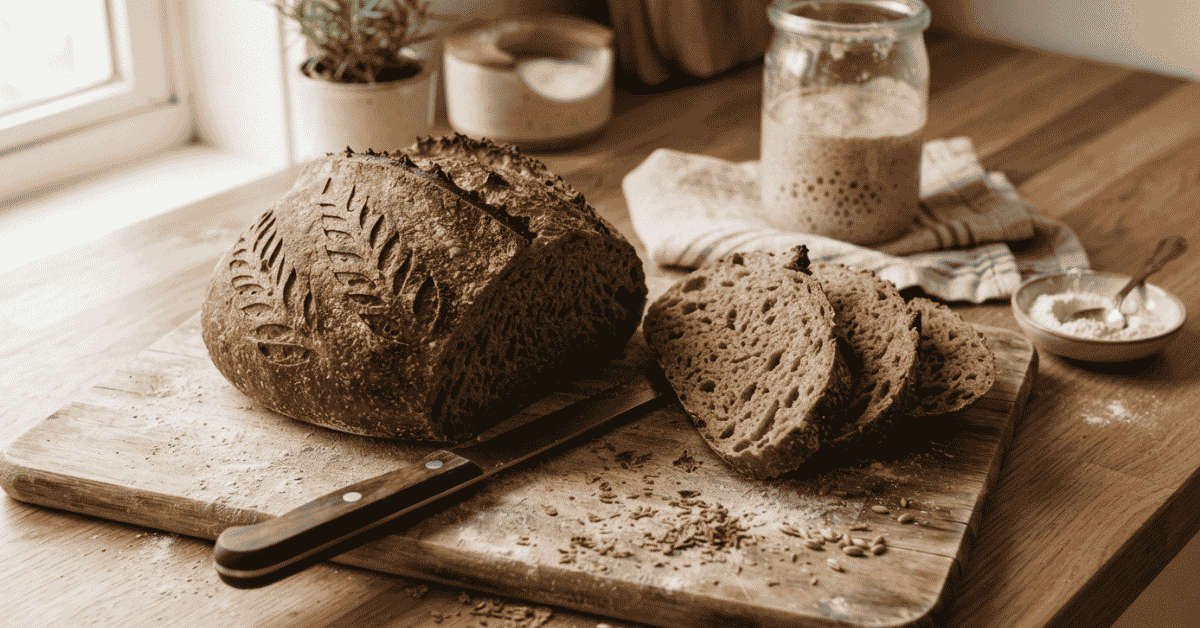
100 Whole Wheat Sourdough Bread Recipe sounds bold, but it is quite simple. I love bread with a deep, nutty taste. Whole wheat gives this loaf that rich bite. Sourdough adds a mild tang and soft crumb. I learned that small steps matter most here. Good flour, a strong starter, and time do the work. I will share the method I use. Grab your jar and let us bake.
Why I Love Whole Wheat Sourdough
I first made this loaf on a slow Sunday. The dough felt rough under my hand. It did not look like white bread dough.
That did not worry me for long. Whole wheat flour holds more of the grain. It can make dough feel firm and dense.
Sourdough changes the loaf too. A live starter brings rise and a light sour taste.
I like this loaf for its:
-
Deep grain taste
-
Soft sour note
-
Chewy crust
-
Rich brown crumb
-
Simple pantry base
The loaf feels rustic, yet it can still have a soft crumb.
What 100 Percent Whole Wheat Means
The term “100 percent whole wheat” matters here. It means the flour comes from the whole wheat grain.
Nothing is swapped for white flour in the main dough.
The whole grain has three key parts:
-
Bran
-
Germ
-
Endosperm
Bran adds fiber and gives the bread a darker look. Germ adds a rich grain taste. The endosperm gives the dough its main starch.
I found that whole wheat dough needs more care. Bran can also cut through gluten strands. That may make the loaf less tall.
So, do not judge the dough by sight alone. Feel matters more.
Ingredients I Use for One Loaf
A short list is all you need. The main goal is balance.
My Basic Ingredient List
-
500 g whole wheat flour
-
400 g water
-
100 g active sourdough starter
-
10 g salt
This gives a dough with high water content. It may feel wet at first.
That is normal. Whole wheat flour can soak up a good deal of water.
Still, I do not add all the water at once. I save some for later.
This lets me check the dough first. Some flour needs less water than others.
Build a Strong Sourdough Starter
A weak starter can make a heavy loaf. I learned this after one flat bake.
The starter should look active before you mix the dough.
Look for signs such as:
-
Bubbles across the jar
-
A fresh sour smell
-
A clear rise
-
A soft, airy look
I like to use the starter near its peak. It should have risen well but not fallen back hard.
A starter that smells sharp or seems flat may need more time.
This step can take more care than the rest. Do not rush it.
Mix the Whole Wheat Dough
I start with the flour and most of the water. I mix them until no dry bits remain.
Then I let the mix rest for a short time. This gives the flour time to take in water.
Next, I add the active starter. I mix it well into the dough.
Salt comes in after that. I add the saved water bit by bit.
At this point, the dough may feel sticky. That does not mean it is wrong.
Wet your hand before touching it. This works better than adding lots of flour.
Too much extra flour can make the loaf dry.
Stretch, Fold, and Build Strength
Whole wheat dough needs strength. Yet I do not knead it hard for long.
I use a gentle stretch and fold method.
My Simple Fold Routine
I pull one side of the dough up. Then I fold it over the center.
I turn the bowl and repeat the move. I do this around the dough.
After each round, the dough feels more smooth.
I repeat the folds at set gaps during the first part of the rise.
You may notice the dough change fast. It can start as a sticky mass. Later, it feels more smooth and holds shape.
That change is a key sign.
Let the Dough Rise With Care
Bulk rise is one of the most vital parts. Time alone does not tell the full story.
Room heat can change the pace a lot. A warm room may speed the rise. A cool room may slow it down.
I look for these signs:
| Stage | Dough Sign | My Check |
|---|---|---|
| Start | Dense and rough | Mix is even |
| Early rise | Slight lift | Fold feels easier |
| Mid rise | More air | Dough feels soft |
| End rise | Puffy shape | Bubbles show |
| Ready | Light and lively | Holds form well |
I do not wait for the dough to double every time. Whole wheat dough can rise in a less clear way.
The dough should look fuller and feel alive.
Shape the Loaf Without Losing Air
After bulk rise, I turn the dough onto a clean work top.
I shape it with gentle hands. I want to build surface tension without crushing the air.
First, I form a loose round. Then I let it rest for a short time.
After that, I shape it again.
A banneton or lined bowl can help hold the loaf. Dust it well with whole wheat flour.
I place the shaped dough inside with the seam up.
The dough then gets its final rest.
Cold Proof and Bake
I often use a cold proof for this loaf. The cold slows the rise and lets the dough rest.
It also makes the dough easier to score.
I place the covered dough in the fridge. The next day, I heat the oven well.
A hot oven helps the loaf rise fast at the start.
My Baking Steps
-
Heat the oven and Dutch oven well.
-
Turn the cold dough onto baking paper.
-
Score the top with a sharp blade.
-
Place it in the hot pot.
-
Bake with the lid on first.
-
Remove the lid near the end.
-
Bake until the crust turns deep brown.
-
Cool the loaf before slicing.
That last step takes real patience.
I know the smell is tempting. Still, cutting too soon can hurt the crumb.
My Tips for a Better Loaf
I made a few mistakes before I found my groove.
Do not chase a perfect shape. Whole wheat dough can be less smooth.
Do not add too much flour. A sticky dough can still bake well.
Do not trust the clock alone. Dough signs matter more than fixed hours.
Do not use a weak starter. Rise starts with the starter.
Do not slice the loaf while hot. Let the crumb set first.
I also found that fresh flour can behave in its own way. Each flour may take water at a different rate.
That is why I keep a small amount of water back.
What I Like and What I Would Change
This loaf has clear strengths. It tastes rich and feels filling. The crust can turn crisp and dark.
The crumb also has a pleasant chew. The sour note can stay mild if the starter is balanced.
Still, it has flaws.
Whole wheat bread may not rise as high as white sourdough. The crumb can also feel more dense.
Some people may want a softer loaf. This recipe leans toward a hearty style.
That is part of its charm for me.
FAQs About 100 Whole Wheat Sourdough Bread Recipe
Can I use a young sourdough starter for this loaf?
A strong, active starter works best. Learn more about starter rise before you bake this whole wheat loaf.
Why does my whole wheat sourdough feel dense?
Weak rise, too much flour, or poor timing may cause this. Learn more about dough signs before baking.
Can I use more water in whole wheat dough?
You can add more water if your flour can take it. Learn more about dough feel before each bake.
How long should whole wheat sourdough cool?
Let the loaf cool well before cutting. Learn more about cooling time and a clean crumb.
Does whole wheat sourdough need a cold proof?
No, but a cold proof can make timing and shaping easier. Learn more about cold proofing this loaf.
Final Takeaway
I still enjoy the calm pace of this bread. The dough asks for time, not force. I watch it rise and learn its feel. The deep grain smell fills the room as it bakes. Then the crust turns dark and crisp. I wait before I cut it. That part is hard, but it pays off. As the fading light hits my desk, I hear the soft sound of my keyboard. The loaf sits close by, cool and ready.